
This summer has seen record-breaking temperatures across the UK, with heatwave after heatwave having a real impact on people’s lives, train travel plans, wellbeing, and more.
But for social housing residents, it’s done more than make homes uncomfortable. It has raised the question: how well is social housing protecting residents during extreme weather?
Over the last few years, the focus has been on warming homes, fuel poverty, and affordability to heat and eat, as well as the broader health of homes and the residents who live in them as we tackle damp, mould, drafts and ventilation.
This summer, research driven and delivered by Acuity shows a powerful link between thermal comfort and trust in the landlord.
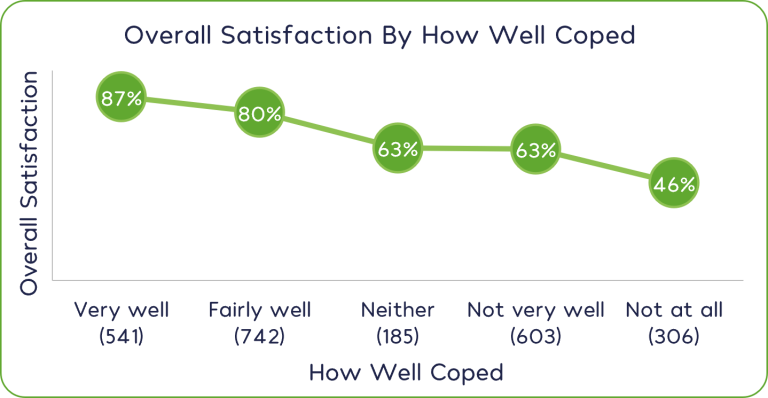
Across 2,402 respondents, overall satisfaction sits at 72% – but this shifts dramatically depending on how well residents feel they coped with the heat. Residents who coped very well reported satisfaction of 87%, while those who felt they haven’t coped at all dropped to 46% – a 41-percentage-point swing.
It’s clear thermal comfort is no longer a “nice to have”. It’s becoming part of how residents perceive their landlord and has started to impact satisfaction.
The Satisfaction Divide
Over the summer months, Acuity worked with 18 social housing providers from across the country to ask residents how well they felt they were coping with the heat:
- 23% said very well – with average overall satisfaction at 87%
- 31% said fairly well
- 8% said neither
- 25% said not very well
- 13% said not at all – with average overall satisfaction at 46%
The satisfaction gradient across these groups is steep, with the clearest correlation suggesting that when homes help residents cope with heat, satisfaction rises. When they don’t, trust erodes.
The Human Impact
As part of our research, we asked what the personal and human impact had been during the heatwaves.
From 2,402 residents, people said:
- Difficulty sleeping – 36%
- Tired/fatigued – 29%
- Existing health conditions worsened – 22%
- Reduced ability to carry out day‑to‑day activities – 20%
- Heat‑related symptoms (dizziness, headaches) – 14%
- Feeling stressed or anxious – 12%
- Difficulty concentrating – 9%
Interestingly, those who reported no noticeable impact (34%) were also the most satisfied with their landlord, with average overall satisfaction at 80%.
Almost two in three residents felt some sort of impact, which was also reflected in their satisfaction scores, with average satisfaction among this cohort at 59%.
What this suggests is that when people feel unwell in their homes, satisfaction becomes emotional – not transactional. Traditionally, we have looked at how services drive satisfaction, but it’s clear that how well people can live in their homes will be an increasingly important factor for landlords to consider.
What Residents Say They Need
When asked what would make a difference, the comments reveal a consistent set of asks, and they show residents already understand the trade‑offs between winter insulation and summer overheating.
The top themes include:
- Air conditioning
- New or better windows
- Better ventilation
- Shutters or external shading
- Improved insulation
- Door repairs/upgrades
- Ceiling or built‑in fans
- Garden/external shading
- Kitchen/bathroom upgrades
Air conditioning dominates the conversation (with over 42% of respondents mentioning this), but residents also express scepticism about cost and feasibility. This shows a nuanced understanding – residents aren’t simply asking for expensive fixes; they’re asking for homes that work all year‑round.
The Landlord Response
Social landlords have spent decades tackling cold, damp and mould. But climate change is shifting the risk profile.
Overheating is now not only a health risk, but a satisfaction risk. It’s a design and retrofit challenge, a trust and reputation consideration – and, if not addressed, a regulatory risk.
It means we need to shift the narrative: Warm Homes? Maybe we should be shifting our focus to Healthy Homes instead.
The data points to a clear opportunity for landlords to rethink asset strategy through a climate‑resilience lens. It can’t just be about how a home performs in winter – it needs to consider whole-year thermal performance, both heating and cooling. This means all retrofit, new-build specifications and other home enhancements need to be assessed for all seasons – not just EPC outcomes.
So, What’s Next?
Residents are telling us something simple: “My home should protect me from the weather.”
When it does, satisfaction rises. When it doesn’t, trust erodes.
The heatwave has revealed a consideration for housing leaders: how can our asset management approach balance thermal comfort, climate resilience and resident wellbeing at any time of the year?
This research is currently ongoing and being carried out with current Acuity clients as part of the added value they receive from working with us over the year. Final results will be published soon. If you’d like to take part or find out more about the range of research, surveys, and insights we provide to the social housing sector, do get in touch.
